Selecting the Right Mycotoxin Binder for Your Poultry Birds
Check with seller
Location
Ghodbunder Road, Thane (W) - 400610 Mumbai, India.
Mumbai, Maharashtra — India
Mumbai, Maharashtra — India
Published
2026-09-15 14:29:34
Contact
Glamac
9930302653
9930302653
Phone Number
09930302653
Description
Mycotoxin contamination negatively affects the economics of commercial poultry farming. It is practically impossible to prevent mycotoxin formation in feed ingredients; hence, it is important to add precautionary measures to reduce mycotoxin contamination, and one of the most popular and widely used methods is the application of mycotoxin binders in feed. There are so many mycotoxin binders available on the market, and hence sometimes it is difficult to choose an appropriate one. In this blog, we will discuss the general criteria on which you focus while selecting the perfect mycotoxin binder for you.
What Are Mycotoxins?
Mycotoxins can be defined as secondary toxic metabolites produced by certain strains of fungi, and they might be present when there is mold growth on the ingredients used for producing animal feed. It is worth mentioning that mycotoxin contamination can happen at any stage of feed production, i.e., in raw material or in finished feed. The presence of mycotoxin in the feed poses a potential threat to the health of poultry birds, their optimal performance, and consumer health. Depending on the level of exposure to mycotoxins, poultry birds may show symptoms like depressed growth, poor performance, being prone to secondary infections, and even death sometimes.
Understanding Mycotoxin Binders For Poultry Birds
Mycotoxin binders work as a substance that traps mycotoxins present in the feed preventing their absorption in the digestive system of the birds. This preventative measure is crucial to alleviate possible adverse effects on the health and performance of the birds. Here you can find some examples of mycotoxin binders below:
Activated charcoal
Aluminosilicate clays: Includes Montmorillonite, Bentonite, Zeolite
Organic binders: Yeast cell wall and micro-ionized fibers
Synthetic polymers
Key Considerations in Selecting Mycotoxin Binders for Poultry Birds
There are a few criteria that can help you know the best mycotoxin binders for poultry birds:
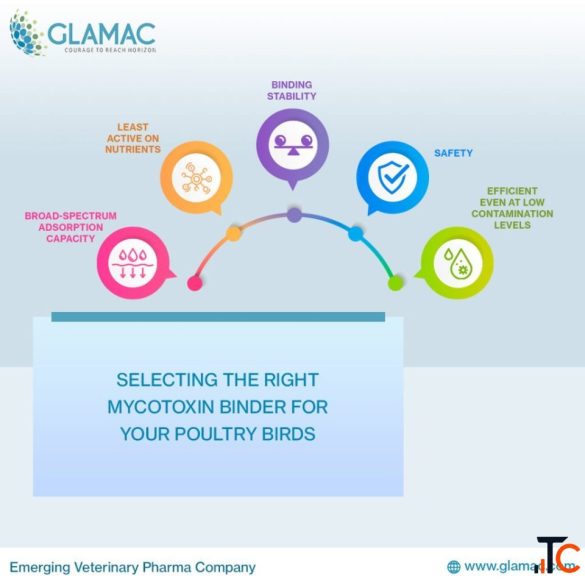
Broad-spectrum adsorption capacity
An effective mycotoxin binder needs to have the capability to absorb both polar and non-polar mycotoxins, encompassing both small and large mycotoxins.
Least active on nutrients
Mycotoxin binders specifically bind the mycotoxins only and should not bind vitamins and micronutrients present in the feed.
Binding stability
The binding of mycotoxin in the gizzard and even not releasing it at neutral or alkaline pH ensures that the complex passes through the intestine and ensures safety for birds.
Safety
Any mycotoxin binder used in poultry feed should be safe for birds, consumers, and the environment. In simple terms, it means the substance must not be harmful and shouldn’t pass into meat or other poultry products.
Efficient even at low contamination levels
Sometimes the mycotoxins are present at low levels, but their synergistic effect can cause a potential negative effect on poultry birds. Therefore, mycotoxin binders should be able to adsorb mycotoxins even when their contamination level is low.
Conclusion
Selecting the right mycotoxin binders for poultry birds is crucial in order to prevent adverse health effects and optimize performance. Key considerations include broad-spectrum adsorption capacity, minimal impact on nutrients, binding stability, safety for birds and consumers, and efficiency even at low contamination levels.